
2026 Round One – Prompt
In Part One of the competition, students are tasked with surveying the external business behaviors of corporations within an industry and creating for themselves a framework for ethical analysis that can be used in all subsequent stages of the competition.
What is the distinction between “a good company” and “a good person”? What obligations does a company have to the larger society?
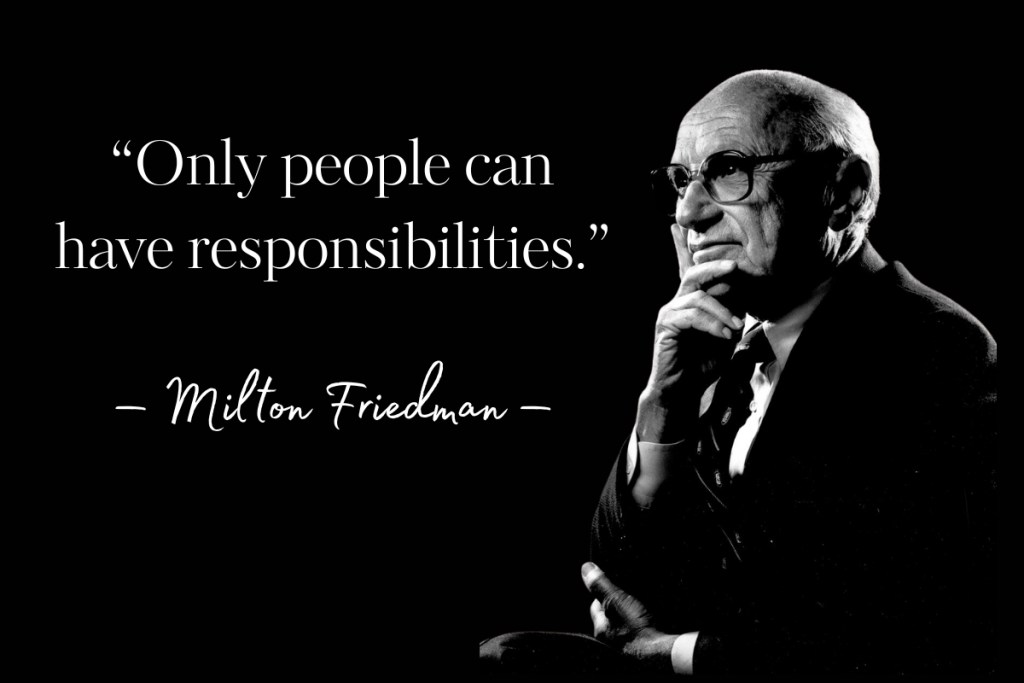
In his September 1970 New York Times Magazine article called The Social Responsibility of Business Is to Increase Its Profits, Milton Friedman concludes that a good company is one that seeks “to use its resources and engage in activities designed to increase its profits so long as it stays within the rules of the game, which is to say, engages in open and free competition without deception or fraud.”
Before attempting your assignment, read the article “The Social Responsibility of Business Is to Increase Its Profits,” by Milton Friedman.
Friedman argues that leaders and managers of companies are employees and therefore agents of the individuals who own the corporation. Therefore, the primary duty of corporate management is to maximize profits for the shareholders, and any pursuit of broader “social” responsibilities that reduce overall returns to investors – such as self-imposed environmental targets or initiatives, enhanced employee benefits, community development investments, or other voluntary philanthropic donations seeking to “do good” – is an improper and unethical use of other people’s money. When a business leader pursues a social cause at the expense of profit and reduces returns to stockholders, “he is spending their money. Insofar as his actions raise the price to customers, he is spending the customers’ money. Insofar as his actions lower the wages of some employees, he is spending their money.”
When corporate leaders direct their company to “do good” by addressing social issues – no matter how popular – Friedman considers that attempt to be an inefficient and short-sighted use of company assets that would be better spent on the business, and overall, an undermining of free-market principles. Friedman is clear that – while following the law – the individuals who manage a business are serving in a role and must look after the interests of shareholders exclusively, focusing on business operations that generate returns and avoiding behavior that could dilute profits.
In 1970 – the same year as Friedman’s article – Bill Daniels purchased the Los Angeles Stars of the American Basketball Association (ABA) and relocated it to Salt Lake City. The people of Salt Lake embraced the Stars and the team flourished, winning the 1971 ABA championship. Unfortunately, the financial troubles of the league led to the Stars’ collapse and bankruptcy: after playing only 16 games in the 1975-76 season, Daniels was forced to close down the team, leaving 3,000 season ticket holders without refunds for unused tickets, and vendors and creditors unpaid.
By 1980, Daniels’ cable business had recovered and allowed him to amass significant personal wealth. Committed to his sense of individual integrity, he personally reimbursed those affected by his company’s bankruptcy five years prior – an entirely voluntary act, as bankruptcy laws did not require repayment. He gave $750,000 of his own money – which included 8% interest – to season ticket holders, vendors, advertisers, sponsors, and shareholders. Daniels reflected, “Boy, I suffered when the Stars went bankrupt. I had no legal obligation to do what I did, but it bugged my conscience … I had to look myself in the mirror every morning and face head-on what happened” — a decision that forever cemented his legacy in Utah. His commitment to his core values is further honored through the Daniels Fund, which has distributed over $1 billion in grants since his death in 2000.
To be clear, free-market advocates would support Daniels’ use of personal assets to do with as he saw fit. In contrast, free-market advocates are troubled by management (even when well-intended) using company assets to implement “good” initiatives merely to satisfy their own moral conscience. Friedman would argue that when these managers seek to make their company “good” by addressing societal or other communal challenges at the expense of profits, they are stealing from investors, reducing the ability of the company to invest in itself, and undermining the free-market system that would provide a far greater benefit overall.
Is “doing good for the world” the same as “good for the company”?
When Johnson and Johnson (“J&J”) withdrew Tylenol from the marketplace in September 1982 (after seven people died consuming Extra-Strength Tylenol capsules poisoned with potassium cyanide), it was universally hailed as a purely virtuous business practice that went above and beyond what was required, but in time, some have disputed that categorization. Since J&J was not responsible for the tampering that led to the deaths and no action was mandated by law, it is widely held that the company’s swift recall of 31 million bottles (costing $100 million), halting production, offering refunds, and developing tamper-evident packaging demonstrated praiseworthy ethical accountability to consumers and society. However, others look at that same behavior and conclude that J&J took these steps not out of altruism, or any ethical obligation to the world around them, but purely out of financial self-interest: to preserve the Tylenol brand and corporate reputation critical for long-term profitability. Tylenol’s market share dropped from 35% to 7% post-crisis but recovered to 30% within a year, largely due to the recall and new packaging. While the company’s decision may have been informed by the company’s credo prioritizing “doctors, nurses, patients, mothers, and fathers”, some argue that the decision was primarily driven by a calculation that inaction would destroy profits.
The “real” reason a corporation engages in “good” or “ethical” business practices is often unclear, or at least multifaceted. In the last five years:
- Patagonia’s founder, Yvon Chouinard, transferred the company’s ownership to a trust and nonprofit, directing all profits (approximately $100 million annually) to combat climate change, rather than distributing them to shareholders or reinvesting for growth.
- Starbucks expanded benefits, including mental health support, parental leave, and college tuition programs for employees, costing millions annually, even for part-time workers, far beyond what maximizes short-term profits.
- PepsiCo’s Food for Good initiative fights hunger by partnering with local organizations to deliver nutritious meals to children and families in underserved communities. The program combines efficient food distribution methods with employee volunteerism to help ensure reliable access to healthy food.
If an organization decides to undertake an initiative that does not seek to maximize profits, but has articulated virtuous intentions and noble reasons for doing so, are the diversions, expenditures, and opportunity costs ever justified?
And what if these initiatives fail?
While they are promoted as well-meaning, and at least partially intended so, not every company’s attempt to “do good for others” ends well. In December 1995, a massive fire destroyed three of nine buildings at Malden Mills, a textile manufacturer in Lawrence, Massachusetts known for Polartec fleece. The fire halted production, threatening 3,000 jobs just before Christmas. Driven by moral conviction and strong community ties, CEO Aaron Feuerstein continued paying workers’ salaries and benefits for 90 days, costing $25 million, and made a public commitment to rebuilding locally rather than relocating. This decision (along with others) led to Feuerstein’s bankruptcy, his losing control of the corporation, and the eventual moving of manufacturing jobs to Tennessee in 2016. Feuerstein himself expressed no regrets and emphasized the company’s ethical duty to attempt what was right for employees.
A different perspective.
In Christopher D. Stone’s influential book Where the Law Ends: The Social Control of Corporate Behavior (Harper & Row, 1975). Stone poses the following hypothetical:
“Suppose that the laboratories of the General Motors Corporation had stumbled on a cure for cancer. Should the management feel obligated to divert the resources necessary to follow up the lead?”
Stone uses this example to explore whether corporations have a moral or social duty to pursue unexpected or unrelated social goods that fall outside their core business (e.g., manufacturing cars), even if the opportunity cost might detract from or even harm shareholders’ interests and the efficiencies of the enterprise. He argues that while pursuing extreme diversions like this might not be expected (as it could disrupt the company’s primary function and efficiency), his broader point is that corporations could start – not with diversions – but by addressing the social harms (e.g., pollution, or unsafe products), rather than pursuing unrelated, voluntary distractions external to the business that help managers feel good about themselves.
Your assignment:
Pick an industry within the U.S. free-market economy that your research indicates engages in “good” or “ethical” business practices that are undertaken (or promoted) as being virtuous, even at the expense of profit.
Then, identify (or imagine) one trade association, industry trade group, business association, etc., that represents the business interests of companies in this industry.
Given the tensions that exist between free-market doctrines, companies seeking to “do good in the world,” and the ethical responsibilities of private individuals, this industry organization has hired your team to advise it on the question: What makes “a good company” in this field, and what do our companies owe to society?
As you establish your answer, consider the range of actions that could be taken by a corporation’s leaders that may prioritize external objectives over the interests of shareholders, thereby spending corporate resources (money, time, or energy) in ways that do not directly (and that may not be intended to) maximize the corporation’s profits in the short run. This may include examples like any of those in the section above but could also include corporate initiatives or philanthropic donations.
Overall, your primary objective is to create an Industry Guide to Ethical Business:
Companies in this industry are looking for a rigorous framework (the questions, tests, measures, principles, etc.) that any company in this industry can use to evaluate (and then approve or reject) internal proposals that seek to “do good” in the world while not increasing profits.
Be clear about how your proposed framework for evaluating business practices align with or depart from Friedman’s free-market arguments, and why. You might provide this industry association with your insights on such fundamental business ethics questions as:
- In a corporation, who determines what is “good,” and who has the responsibility to do good (Is it Owners / Investors? Management? Individual employees? Charities / NGOs? Governments?), and how do those responsibilities differ?
- Do externally focused initiatives that seek to do good at the expense of profit take money inappropriately from investors, the business, employees, and customers (in the form of higher prices)? Under what conditions do you find this ethically justified, and why?
- Do you agree or disagree with Friedman’s statement that “only individuals have responsibilities”? Are the responsibilities of a private individual different when serving in the role of corporate manager, or employee? How?
More specifically (and more practically): in about 2,000 words (you may add 3 charts or images to provide clarity):
- Utilize a thorough process of analysis to understand and then articulate the primary ethical and free-market dilemmas related to social initiatives that are common or could be present in the industry you’ve chosen. Explicitly articulate these dilemmas and the risks faced by industry association members and be clear about why these are difficult and complex for members.
- Apply the principle-based framework of Bill Daniels ethics principles (linked here) to address these ethical and free-market dilemmas you’ve identified and offer recommendations that make good business sense for the association’s membership. Given the risks and dilemmas that you have identified and seek to address, what externally focused activities should be required, encouraged, discouraged, or prohibited for companies in this industry, and how do you justify the guidelines you propose?
- Acknowledge, appreciate, and respectfully address alternate viewpoints (different ways of analyzing and resolving these dilemmas) that do not align with your own.
- Present your analysis, recommendations, and recognition of disagreement in a clear, logical, and persuasive style appropriate to an executive engagement.
In addition to these four criteria above, judges will also consider:
Did your work demonstrate courage? Were your recommendations for resolving dilemmas bold and creative?
Does your work demonstrate an understanding of principle-based ethics?
Did you demonstrate a solid understanding of “the free-market” and “the profit motive,” and why these are inherently valuable?
Did your work articulate the long-term impact of ethical behavior on the marketplace?